Réunion d’AVIGNON :2 juillet 2015

A. GUEIFFIER étant nouveau Président de l’AFECT, souhaiterait passer la main concernant sa responsabilité dans la commission pédagogie. Suite au séminaire de Toulouse, P. DALLEMAGNE nous a transmis 3 intéressantes questions-type concernant le médicament et qui ne peuvent être expliquées que par la chimie. D'autres questions aussi éclairantes sont en cours d'élaboration par nos collègues, en particulier par nos collègues de Marseille. En ces temps où le rôle et l'intérêt de la chimie est remis en question dans nos Facultés, ces questions sont destinées à convaincre à la fois les étudiants et nos collègues d'autres disciplines que la chimie est incontournable pour qui s'intéresse au médicament.

Membres excusés : Line BOUREL, Marie COCHARD, Caroline DUCROS, Philippe URIAC, Pierre VERHAEGHE, Michel VIDAL

Participants par visioconférence : Michel BOISBRUN et Caroline DECOMBAT. Invitée : Christine PEPIN-CONTINO

Présents : Sandrine ALIBERT, Marc-Antoine BAZIN, Pascal BERTHELOT, Pascal CARATO, Philippe CHAVATTE, Patrick DALLEMAGNE, Catherine FAGNÈRE, Stéphane GÉRARD, Alain GUEIFFIER, Cécile GUEIFFIER, Martine LEMBÈGE, Vincent LISOWSKI, Nicolas MASURIER, Alain NUHRICH, Christelle POUGET, Janos SAPI, Anne-Sophie VOISIN-CHIRET, Said YOUS.

1. Retour sur le séminaire de printemps réalisé à TOULOUSE (26 et 27 mars 2015)

– Merci à Pierre VERHAEGHE pour l’accueil et l’organisation. Nous étions 21 personnes.

   Commission Pédagogie 

  • A. GUEIFFIER étant nouveau Président de l’AFECT, souhaiterait passer la main concernant sa responsabilité dans la commission pédagogie.
  • Suite au séminaire de Toulouse, P. DALLEMAGNE nous a transmis 3 intéressantes questions-type concernant le médicament et qui ne peuvent être expliquées que par la chimie.
    D’autres questions aussi éclairantes sont en cours d’élaboration par nos collègues, en particulier par nos collègues de Marseille. En ces temps où le rôle et l’intérêt de la chimie est remis en question dans nos Facultés, ces questions sont destinées à convaincre à la fois les étudiants et nos collègues d’autres disciplines que la chimie est incontournable pour qui s’intéresse au médicament.

 Commission Internat 

En font partie (entre autres) : M. VIDAL et V. LISOWSKI. Le CNCI travaille actuellement à l’actualisation de la base de données des questions du concours, mais sans en ajouter de nouvelles.

Commission e-learning 

J.-F. PEYRAT + travaux de A. HAMZÉ et A. NUHRICH.

Alain NUHRICH a présenté son application type QCM pour l’entraînement à des questions de Chimie Thérapeutique.

Abdallah HAMZÉ était absent mais a transmis une vidéo présentant des questions de CT avec une intéressante interface graphique permettant l’affichage de formules. Ces questions sont hébergées sur son site internet perso (via Paris XI) mais il est ok pour une diffusion à tous les étudiants en pharmacie de France qui en auraient besoin, via le nouveau site internet de l’AFECT. Cela permet un entraînement efficace des étudiants.

 Le site internet 

Présenté par A. NUHRICH : déjà bien avancé avec une présentation soignée et un espace à part prévu pour les membres de l’AFECT (A voir comment organiser cette commission. Il faudrait certainement un soutien de personnes motivées car il y a pas mal de boulot pour rentrer le contenu sur le site. Ce point sera abordé lors de la prochaine réunion du bureau. A. NUHRICH et N. MASURIER seront conviés à la visioconférence.

AG Annuelle faite à Toulouse 

  1. Rapport moral : la moralité est bonne  
  2. Rapport financier : reste en positif 12 700 euros : cotisations + royalties des traités de CT.
  3. CNU : voir + loin
  4. Conseil d’administration et Bureau. Bureau élu pour 3 ans, renouvelable une fois.

Nouveau président : cf le CR de la réunion de l’AG de Toulouse.

On a proposé de lancer l’appel à cotisation en nov-décembre, puis pour les retardataires un rappel peu avant le séminaire de printemps.

Prochains séminaires

• MARSEILLE : printemps 2016 (sans doute 25-26 mars)
• CAEN : printemps 2017

2. Qualification aux fonctions de Professeur  

– A. HAMZÉ a exprimé son désir de la préparer, peut-être d’autres aussi ? Il faudra prévoir les séances d’entraînement à l’automne.

– Campagne d’emploi : à Caen, Anne-Sophie VOISIN-CHIRET a été nommée PR.

3.  Révision des statuts

– Il faudrait lister tous les enseignants de la discipline dans toutes les facs de Pharmacie de France.
– Les statuts ont été déposés en 1980. Lieu de dépôt ? Cela aurait été fait à la préfecture de Police de Paris.
Ces statuts sont obsolètes. Ex : à cette époque le statut de MCF n’existait pas, il y avait des assistants et des Maîtres-assistants. Il est écrit qu’il faut être enseignant en chimie thérapeutique en pharmacie, ce qui pourrait être changé dans un sens d’élargissement à d’autres collègues, pourquoi pas des gens des facultés des sciences. L’objectif serait de rédiger de nouveaux statuts actualisés mais aussi assez minimalistes. L’essentiel des détails serait inclus dans un règlement intérieur qui serait par la suite plus facile à faire évoluer.

4. Relations avec la SCT

Echanges avec Janos SAPI, Président de la SCT. On peut noter une désaffection des universitaires dans la participation à la SCT en général (en terme d’adhésion) et aux RICT en particulier. Les RICT ont beaucoup changé : nombreux pays représentés, environ 50% de participants étrangers sur environ 450. Il y a de moins en moins de conférenciers français. L’inscription coûte de + en + cher à l’heure où les labos ont de moins en moins d’argent. Le programme est très dense et il n’y a pas assez de place pour les jeunes pour présenter leurs travaux. Peu de synthèse présentée.

Il semble que désormais les chercheurs français vont à des congrès plus pointus dans leur domaine.
J. SAPI insiste sur d’autres manifestations patronnées par la SCT : la journée des jeunes chercheurs l’hiver et surtout les Journées Thématiques de la SCT: pas cher (70 euros pour les membres de la SCT) et plus de personnes issues du monde académique. Elles ont lieu à l’automne et au printemps. Les prochaines : le 16 octobre à Dijon.

Seul V. LISOWSKI est présent au Conseil Scientifique de la SCT, il faudrait que d’autres membres de l’AFECT s’y impliquent aussi.

Le site internet de la SCT a été récemment actualisé. P. DALLEMAGNE suggère de communiquer à la SCT l’existence de formations à la recherche en chimie médicinale et Drug Design (Masters comme à Caen) pour en faire la publicité. Il faudrait aussi intégrer cette information sur le site de l’AFECT.

5. Questions diverses

  • Adhésions :

Guillaume BERNADAT a demandé à adhérer à l’AFECT : MCF Paris XI depuis 2013 : absent à Avignon mais sera présent à Marseille en 2016. Sa candidature est parrainée par C. GUEIFFIER et V. LISOWSKI

  • CNU : à renouveler partiellement :

Rang A : Alain GUEIFFIER se présente.

Rang B : Caroline DUCROS se présente.

L’élection se fera par correspondance à l’automne.

  • Une prochaine réunion du bureau par visioconférence aura lieu à l’automne, la précédente ayant eu lieu le 11 juin dernier.

Caroline DECOMBAT
Partager:

Plus articles

EFMC International Symposium on Medicinal Chemistry Bâle, Suisse

The EFMC International Symposium on Medicinal Chemistry is organised by the Division for Medicinal Chemistry & Chemical Biology (DMCCB) of the Swiss Chemical Society (SCS), on behalf of the European Federation for Medicinal chemistry and Chemical biology (EFMC). The symposium will take place in Basel, Switzerland from September 6-10, 2026.  The EFMC is the main organisation for the European Medicinal Chemistry and Chemical Biology community, with 31 member societies and about 9.000 members. Its biennial EFMC Medicinal Chemistry is a key symposium in the field of medicinal chemistry and drug discovery and it traditionally attracts around 1.000 participants both from industry and academia. The most recent EFMC-ISMC meeting took place in Rome (Italy, 2024). The scientific programme of EFMC Medicinal Chemistry 2026 will run over 5 days and will include plenary sessions and cover a wide range of selected topics split into 3 parallel sessions. We look forward to welcoming you to Basel in September! Organised by With the Support of Gold Sponsors Silver Sponsor Bronze Sponsors Media Partners

60th edition of the International Conference on Medicinal Chemistry

The French Medicinal Chemistry Society (Société de Chimie Thérapeutique – SCT) is pleased to invite you to Paris, France on July 1-3, 2026 for the 60th edition of the International Conference on Medicinal Chemistry (RICT 2026). The conference will be dedicated to “Interfacing Chemical Biology and Drug Discovery” and will include 18 plenary lectures and 6 short lectures. In addition, 2 plenary lectures will be delivered by the recipients of the Novalix SCT Award for Drug Discovery Chemistry and the Evotec Prize for Excellence in Molecular Design. As for previous editions of RICT, the scientific committee will ensure the high quality and diversity of the scientific programme together with the accessibility of the meeting to PhD/post-doc and local Master students. For the latter, an advantageous registration fee will be offered. In addition, a poster session will provide the opportunity for all participants to present their current results. Poster prizes will be attributed at the end of the meeting. A limited number of grants will be funded by the SCT and Corporate Sponsors to support the participation of young academic scientists presenting a poster at the conference. Find out more. Moreover, a special career session will be organised with industrial and academic participants. We look forward welcoming you in Paris! The Organising Committee Organised by Supported by EFMC Sponsored Event Gold Sponsor Silver Sponsor Bronze Sponsors Media Partners

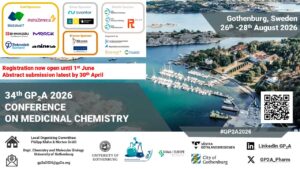
34th GP2A 2026 Conference on Medicinal Chemistry – Gothenburg, Sweden – August 26th to 28th 2026

Dear Colleagues, Dear Researchers, The GP2A (Group for the Promotion of Pharmaceutical chemistry in Academia) is delighted to announce the 34th GP2A 2026 Conference on Medicinal Chemistry, hosted by the City of Gothenburg, the Västra Götaland Region and Department of Chemistry and Molecular Biology at the University of Gothenburg, Sweden, 26–28 August 2026. The Conference is organized in collaboration with the SIGMA-1 Europe Cost Action (https://sigma1europe.eu/) The conference venue is the brand-new Natrium Research Building, a state-of-the-art facility in the Faculty of Science and Technology. City of Gothenburg/Göteborg Gothenburg. Always in progress. EN on Vimeo and Gothenburg official visitors guide www.goteborg.com/en  Welcome to Göteborg, Sweden’s vibrant coastal city where innovation meets Scandinavian charm. Set on the edge of a stunning archipelago, Göteborg offers a unique blend of maritime heritage, modern culture, excellent cuisine, and a relaxed, walkable city center. From picturesque canals and historic neighborhoods to world-class dining and green spaces, Göteborg provides the perfect setting for inspiring discussions and memorable conference experiences. Useful links for Gothenburg Tickets for public transport in Gothenburg – Download Link of the Mobile App of Västtrafik https://apps.apple.com/se/app/västtrafik-to-go/id424903083 Here is the link to the android app: https://play.google.com/store/apps/details?id=com.vaesttrafik.vaesttrafik&hl=sv You can find a description for the way from the suggested hotel (Comfort Hotel Panorama) here. You can find a description for the way from the other suggested hotel (Comfort Hotel Göteborg) here. Please find a link to a bus connection from Landvetter Airport to Gothenburg city (Station: Korsvägen) here. Conference Venue The Natrium Research Building, located on Medicinaregatan 7B in Gothenburg, offers modern lecture halls, teaching labs, and exhibition spaces, making it an ideal setting for an international scientific meeting. Participants will also have the opportunity to explore Gothenburg, a vibrant and beautiful city on Sweden’s west coast. Scientific Programme Scientific Programme Mark Brönstrup, Helmholtz Centre for Infection Research, Germany Magnus J. Johansson, AstraZeneca & Stockholms Universitet, Sweden Silvia Ortega Gutiérrez, Universidad Complutense de Madrid, Spain Maria Duca, CNRS Université Côte d’Azur, France Matt Todd, University College London, United Kingdom Laurence Lafanechère, Saxol & CNRS Université Grenoble Alpes, France Nina Hartrampf, University of Zurich, Switzerland Tangui Maurice, CNRS, INSERM U1198, France Carmen Abate, Università Degli Studi Di Bari, Italy Johannes Broichhagen, Leibniz Research Institute for Molecular Pharmacology, Germany Ed Tate, Imperial College London, UK …and more to come. Confirmed Scientific Sponsor Presentation Alexander Neumann, BioSolveIT, Germany Björn-Thoralf Erxleben, Shimadzu Sverige, Sweden Mikael Friberg, Merck Life Sciences, Sweden The preliminary Program is available HERE. Flyer: Available here. Hands-on Workshop – Modeling with SeeSAR by BioSoveIT (https://www.biosolveit.de/) With an exciting hands-on learning session with the title “Medicinal Chemistry in Motion: Introduction to Rational Compound Design” BioSolveIT will contribute to our scientific programme.  You will learn how structure-based drug design supports lead optimization by turning binding-mode insights into actionable ideas for decorating and improving ligand scaffolds.What makes BioSolveIT workshops special is their interactive, beginner-friendly format: using our drug design dashboard SeeSAR, you can explore binding prediction, fragment-growing strategies, scaffold exploration, and more. No computational chemistry expertise required, though experts will find plenty of depth. Please bring your own laptop and install SeeSAR in advance (find instructions here: https://www.biosolveit.de/workshops/gp2a-2026/); registered participants will receive a workshop license so you can continue testing the software for several weeks after the session. Please find instruction for the installation and the registration to the workshop here: https://www.biosolveit.de/workshops/gp2a-2026/. Please note that only people registered to the conference will have access to the workshop. Registration and Conference fee Registration and fees: You can pay either by credit card or bank transfer (via purchase order for French colleagues). The fee includes the welcome reception on Wednesday evening, lunch on Thursday and Friday, and coffee breaks on all days. The dinner and social activity are optional at €68. Category Fee [€] Junior Researcher & GP2A Member 150 Junior Researcher 170 Senior Researcher & GP2A Member 300 Senior Researcher 330 Sponsor 330 Junior Researcher: PostDocs, PhD and Master students Senior Researcher: PIs, Professor, Lecturer   If you are not already a member, and would like to join GP2A, please use the following link: https://gp2a.org/index.php/gp2a-membership/ Please register here: https://gp2a.s2.yapla.com/en/event-101283/ Registration opens on 31th of January 2026. Book your seat early, there are limited seats available. Deadline for registration is the 1st of June 2026. Abstract submission The abstract template for young researcher presentations, poster-pitches and poster presentations and information for the submission are available here. Please submit your abstract exclusively using the dedicated word template as a DOCX file here by the 30th of April 2026.  Please note that abstracts not fulfilling the template format will not be accepted. Abstract submission and poster/communication will eventually not be considered if the main author is not fully registered as a participant to the conference by the closing date for abstract submission (1st of June 2026). Young Researcher Presentations and Poster Pitches: The organizing committee will select 10 attendees from the submitted abstracts for a Young Researcher Presentation (15 + 5 min)and 20 attendees for a Poster Pitch (3 min). Please select “no communication” during the abstract submission process, in case you do not wish to be considered for any oral communication, to notify the organizing committee of your preference. Participants selected for Young Researcher Presentations and Poster Pitches will be notified shortly no later than 1st of June 2026. The date for final registration (without abstract submission) is 1st of June 2026. Prizes will be awarded for the Best Posters, Best Poster Pitch and Best Young Researcher Presentation. Social Programme Welcome Reception On the evening of the 26th of August we will have a Welcome Reception in the Atrium of the conference Venue with food and beverages. the Welcome Reception is included in the conference fee. Conference Dinner: An Evening Cruise through the Gothenburg Archipelago You can find a description for the way from the conference venue to the departure point of the conference dinner cruise Lilla Bommens hamn here. We invite you to a truly unique conference dinner and social activity on board the historic M/S St. Erik. Experience a 3-hour boat tour through the stunning Gothenburg archipelago, offering breathtaking coastal scenery, open waters, and unforgettable views. On board, guests will enjoy a Shrimp & Salmon Seafood Dinner, served in a relaxed and elegant maritime atmosphere. The dinner includes one drink (wine or beer) and table water. Additional beverages will be available for purchase on board.  Vegetarian, vegan or other dietary restrictions will be considered when communicated during registration. This special