Réunion du Conseil d’Administration de l’AFECT

Membres présents : PUDLO Marc (Besançon), BADARAU Edouard (Bordeaux)

Membres présents : PUDLO Marc (Besançon), BADARAU Edouard (Bordeaux), NUHRICH Alain (Bordeaux), DALLEMAGNE Patrick (Caen), DECOMBAT Caroline (Clermont-Ferrand), BOSC Damien (Lille), LEBEGUE Nicolas (Lille), PRIMAS Nicolas (Marseille), BAZIN Marc-Antoine (Nantes), BESSON Thierry (Rouen), BOUREL Line (Strasbourg)

Membre excusé : VOISIN-CHIRET Anne Sophie (Caen)

Ordre du jour :

1/ Cotisations et relances (Nicolas P.)
2/ Point sur le Prix AFECT-SCT-AECOP (Line B.)
3/ Compilation des TP (Caroline D., Marc-Antoine B., Alain N.)
4/ Recensement des formations (Edouard B.) et guide ANEPF (Line B.)
5/ Collection Objectif Internat (Line B.)
6/ Questions ChThé pour l’internat (Marc P.)
7/ Traduction du référentiel (Marc P., Thierry B.)
8/ Séminaire de printemps
9/ Point sur la veille scientifique et pédagogique des mb du CA
10/ Points divers

1/ Cotisations et relances

Après avoir dressé le bilan financier de l’AFECT, notre trésorier Nicolas PRIMAS mentionne que 83 adhérents de l’AFECT sont à jour de leur cotisation. Seuls deux-trois adhérents n’ont toujours pas régularisé leur cotisation.

N. PRIMAS évoque le souhait de M-N PALUDETTO, prix de thèse Alain Gueiffier 2020, de quitter l’association.

Le prochain appel à cotisation est prévu lors du prochain séminaire (mars 2022).

2/ Prix AFECT-SCT-AECOP : Prix Wermuth Best educator in MedChem

Line BOUREL rappelle que ce prix proposé conjointement avec la SCT (R. DÉPREZ-POULAIN) et l’AECOP (N. WILLAND) est un prix pédagogique mettant en avant l’enseignement de la chimie médicinale et de la chimie en pharmacie, en termes de qualité et d’innovation. Ce prix permettra de renforcer les liens avec les sociétés sœurs.

Deux axes émergent : l’enseignement de la chimie (organique et thérapeutique) en Pharmacie (niveaux DFGSP, DFASP) et l’enseignement aux niveaux Masters-Doctorat par ceux qui forment à la chimie médicinale.

Ce prix aurait pour nom : « Prix Wermuth des meilleurs enseignants en Chimie Organique et Thérapeutique », en l’hommage à l’illustre Pharmacien, Professeur de Chimie Organique et de Chimie Médicinale de Strasbourg, auteur de l’ouvrage de référence « The Practice of Medicinal Chemistry ».

Le montant du prix est discuté : l’AFECT serait susceptible de participer à hauteur de 400-450€, de même que la SCT et l’AECOP environ 150€, soit un total d’environ 1 000€ ; par ailleurs, le lauréat pourrait bénéficier d’une adhésion à une association, d’une participation aux RICT.

Ceci est couplé à la volonté d’organiser un webinaire pédagogique (date à confirmer, fin d’année universitaire) au cours duquel le lauréat présentera son projet.

Concernant la date, l’ouverture aux candidatures serait fixée de février 2022 à mai 2022.
Un jury formé de personnes des trois associations SCT/AFECT/AECOP étudierait les candidatures comprenant un mini-CV (1 page), un descriptif de leur équipe pédagogique et de leurs actions menées.

Ces candidatures seront à adresser à une adresse générique de l’AFECT (prix.wermuth@afect.fr)

A. NUHRICH va se charger de créer des adresses mail @afect.fr qui seront testées par les secrétaires. Il nous informe qu’une mise à jour majeure de JOOMLA a été réalisée. Elle est gratuite. En revanche, les extensions actuelles ne fonctionneraient plus avec la mise à jour. Il faudrait faire une mise à jour des extensions.

T. BESSON propose que cette récompense soit attribuée à une équipe pédagogique et non à titre individuel.
Il serait possible d’orienter la thématique du prix chaque année.

3/ Compilation des TP, partage des ressources

A ce jour, seuls les membres du CA ont été sollicités afin de partager leurs ressources.

Ont participé : L. BOUREL (Strabsourg), M. PUDLO (Besançon), E. BADARAU (Bordeaux), D. BOSC et N. LEBÈGUE (Lille), C. DECOMBAT (Clermont Fd).

En attente : T. BESSON (Rouen), A.S. VOISIN-CHIRET (Caen), N. PRIMAS (Marseille), M.-A. BAZIN (Nantes)
M.-A. BAZIN a trouvé des difficultés car il a tenté de déposer seul ses ressources.

A part M.-A. BAZIN, il n’y a pas eu de nouveau dépôt.

Il est rappelé que les ressources partagées de TP sont accessibles à tous les enseignants titulaires qui auront partagé un document.

Un fichier pour un principe actif : synthèse, études physicochimiques etc.

Ce partage doit se faire en consensus avec nos collègues au sein de l’UFR.

Il a été demandé à A. NUHRICH de vérifier que l’accès était bien confidentiel. Il est désormais possible de faire un appel auprès des enseignants titulaires, membres à jour de leur cotisation.

Les ressources sont assez homogènes, quelques redondances mais c’est très complémentaire. L’interface est conviviale. Le travail réalisé par A. NUHRICH est réussi.

4/ Recensement des formations de Masters en chimie médicinale, guide de l’ANEPF

E. BADARAU a réalisé un important travail de recensement des formations de Masters (niveaux M1/M2) en « Medicinal Chemistry » et « Chemical Biology » impliquant des enseignants de l’AFECT.

Un bilan a été dressé concernant dans un premier temps les UFR de Santé et UFR de Sciences Pharmaceutiques et Biologiques.

Afin de poser des limites à cet inventaire et à mentionner toutes les formations dispensées en UFR des Sciences, l’objectif, dans un premier temps, est d’avoir une tribune pour répertorier les enseignements de MedChem impliquant nos formations et nos enseignants.

Par ailleurs, L. BOUREL a pris contact avec l’ANEPF qui met en ligne un format type  recensant ce type de formations dans leur guide.

Rq : l’item chimie médicinale n’est plus présent sur le site de l’ANEPF.

5/ Questions Chimie Thérapeutique au concours de l’Internat

La chimie médicinale est insuffisamment présente dans les questions posées au Concours de l’Internat.
La question est la suivante : que peut-on faire à notre échelle pour la promotion de la chimie thérapeutique (RSA, pKa, stéréochimie, équilibres acido-basiques, …) afin d’être davantage intégrée dans ces questions ?

Un des problèmes est l’incapacité à intégrer des structures chimiques dans les questions, la faute à l’utilisation de logiciels archaïques. L. BOUREL devrait envoyer un courrier au Ministère pour demander que le concours passe sur SIDES NG afin de pouvoir insérer des structures dans les questions. Il faut s’appuyer sur le rapport de l’académie nationale de pharmacie pour la défense de la chimie dans les études de pharmacie.

M. PUDLO, C. DECOMBAT, N. LEBÈGUE et D. BOSC ont la possibilité de fournir des questions et des QCM pour pallier ce déficit. V. LISOWSKI sera également contacté pour connaître l’état des lieux de ce dossier.

C DECOMBAT et  M. PUDLO ont quitté la réunion.

6/ Collection Objectif Internat

L. BOUREL a été sollicitée par le Pr S. FAURE (Pharmacologie, Univ. Angers) pour intégrer des notions de chimie médicinale (relations structure-activité, structures chimiques, …) dans un ouvrage préparant au concours de l’Internat qui paraîtra en 2024.

Les modalités doivent être amenées à être plus clairement définies avec le Pr S. FAURE.

M. PUDLO, M.-A. BAZIN et D. BOSC se portent volontaires pour participer à ce groupe de travail.

C. DECOMBAT est revenue en réunion.

7/ Traduction du Référentiel de Chimie Thérapeutique

Ce travail sera prochainement entrepris par M. PUDLO et T. BESSON.

8/ Séminaire de printemps

Les dates du prochain séminaire de printemps de l’AFECT sont les 24-25 mars 2022. Pascal CARATO (Univ. Poitiers) est en charge de l’organisation locale de cette manifestation.

Devant la situation sanitaire actuelle (et future…), il est évoqué la possibilité de faire ce séminaire en mode hybride (présentiel + distanciel). Caroline DECOMBAT doit contacter P. CARATO pour définir des modalités, du nombre de participants éventuels en présentiel et en distanciel.

Le programme devra être prochainement mis à jour puis communiqué aux membres de l’AFECT.

9/ Point sur la veille scientifique et pédagogique des membres du CA

E. BADARAU propose d’enrichir les liens sur le site de l’AFECT portant sur la chimie médicinale : données, vidéo Youtube, Mooc etc.

C. DECOMBAT demande si le Rapport de l’Académie Nationale de Pharmacie intitulé « Chimie pour la Pharmacie et les Sciences pharmaceutiques » publié le 8 décembre 2021 peut être diffusé à l’ensemble des membres de l’AFECT. Tous les membres du CA y sont favorables.

10/ Points divers

N. PRIMAS évoque le cas de Bertrand COLLIN (Univ. de Bourgogne) sur la possibilité de son adhésion à l’AFECT. Ce sujet sera à nouveau abordé au prochain CA de l’AFECT prévu le 10/03/22, après avoir pris des renseignements auprès de M. PUDLO qui a dû quitter la réunion avant la fin.

L. BOUREL se charge d’envoyer à N. PRIMAS les éléments nécessaires à la mise à jour des statuts de l’association et des questions d’ordre bancaire.

Pour rappel, il est demandé aux membres du bureau une photo d’identité pour mettre sur le site internet.

L’ordre du jour étant épuisé, la séance est levée à 17h10.


Rappel : prochaines réunions de bureau :
                        – jeudi 10/03/22 (#4) 14h
                        – jeudi 19/05/22 (#5) 14h
Partager:

Plus articles

EFMC International Symposium on Medicinal Chemistry Bâle, Suisse

The EFMC International Symposium on Medicinal Chemistry is organised by the Division for Medicinal Chemistry & Chemical Biology (DMCCB) of the Swiss Chemical Society (SCS), on behalf of the European Federation for Medicinal chemistry and Chemical biology (EFMC). The symposium will take place in Basel, Switzerland from September 6-10, 2026.  The EFMC is the main organisation for the European Medicinal Chemistry and Chemical Biology community, with 31 member societies and about 9.000 members. Its biennial EFMC Medicinal Chemistry is a key symposium in the field of medicinal chemistry and drug discovery and it traditionally attracts around 1.000 participants both from industry and academia. The most recent EFMC-ISMC meeting took place in Rome (Italy, 2024). The scientific programme of EFMC Medicinal Chemistry 2026 will run over 5 days and will include plenary sessions and cover a wide range of selected topics split into 3 parallel sessions. We look forward to welcoming you to Basel in September! Organised by With the Support of Gold Sponsors Silver Sponsor Bronze Sponsors Media Partners

60th edition of the International Conference on Medicinal Chemistry

The French Medicinal Chemistry Society (Société de Chimie Thérapeutique – SCT) is pleased to invite you to Paris, France on July 1-3, 2026 for the 60th edition of the International Conference on Medicinal Chemistry (RICT 2026). The conference will be dedicated to “Interfacing Chemical Biology and Drug Discovery” and will include 18 plenary lectures and 6 short lectures. In addition, 2 plenary lectures will be delivered by the recipients of the Novalix SCT Award for Drug Discovery Chemistry and the Evotec Prize for Excellence in Molecular Design. As for previous editions of RICT, the scientific committee will ensure the high quality and diversity of the scientific programme together with the accessibility of the meeting to PhD/post-doc and local Master students. For the latter, an advantageous registration fee will be offered. In addition, a poster session will provide the opportunity for all participants to present their current results. Poster prizes will be attributed at the end of the meeting. A limited number of grants will be funded by the SCT and Corporate Sponsors to support the participation of young academic scientists presenting a poster at the conference. Find out more. Moreover, a special career session will be organised with industrial and academic participants. We look forward welcoming you in Paris! The Organising Committee Organised by Supported by EFMC Sponsored Event Gold Sponsor Silver Sponsor Bronze Sponsors Media Partners

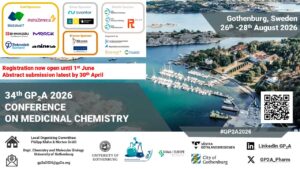
34th GP2A 2026 Conference on Medicinal Chemistry – Gothenburg, Sweden – August 26th to 28th 2026

Dear Colleagues, Dear Researchers, The GP2A (Group for the Promotion of Pharmaceutical chemistry in Academia) is delighted to announce the 34th GP2A 2026 Conference on Medicinal Chemistry, hosted by the City of Gothenburg, the Västra Götaland Region and Department of Chemistry and Molecular Biology at the University of Gothenburg, Sweden, 26–28 August 2026. The Conference is organized in collaboration with the SIGMA-1 Europe Cost Action (https://sigma1europe.eu/) The conference venue is the brand-new Natrium Research Building, a state-of-the-art facility in the Faculty of Science and Technology. City of Gothenburg/Göteborg Gothenburg. Always in progress. EN on Vimeo and Gothenburg official visitors guide www.goteborg.com/en  Welcome to Göteborg, Sweden’s vibrant coastal city where innovation meets Scandinavian charm. Set on the edge of a stunning archipelago, Göteborg offers a unique blend of maritime heritage, modern culture, excellent cuisine, and a relaxed, walkable city center. From picturesque canals and historic neighborhoods to world-class dining and green spaces, Göteborg provides the perfect setting for inspiring discussions and memorable conference experiences. Useful links for Gothenburg Tickets for public transport in Gothenburg – Download Link of the Mobile App of Västtrafik https://apps.apple.com/se/app/västtrafik-to-go/id424903083 Here is the link to the android app: https://play.google.com/store/apps/details?id=com.vaesttrafik.vaesttrafik&hl=sv You can find a description for the way from the suggested hotel (Comfort Hotel Panorama) here. You can find a description for the way from the other suggested hotel (Comfort Hotel Göteborg) here. Please find a link to a bus connection from Landvetter Airport to Gothenburg city (Station: Korsvägen) here. Conference Venue The Natrium Research Building, located on Medicinaregatan 7B in Gothenburg, offers modern lecture halls, teaching labs, and exhibition spaces, making it an ideal setting for an international scientific meeting. Participants will also have the opportunity to explore Gothenburg, a vibrant and beautiful city on Sweden’s west coast. Scientific Programme Scientific Programme Mark Brönstrup, Helmholtz Centre for Infection Research, Germany Magnus J. Johansson, AstraZeneca & Stockholms Universitet, Sweden Silvia Ortega Gutiérrez, Universidad Complutense de Madrid, Spain Maria Duca, CNRS Université Côte d’Azur, France Matt Todd, University College London, United Kingdom Laurence Lafanechère, Saxol & CNRS Université Grenoble Alpes, France Nina Hartrampf, University of Zurich, Switzerland Tangui Maurice, CNRS, INSERM U1198, France Carmen Abate, Università Degli Studi Di Bari, Italy Johannes Broichhagen, Leibniz Research Institute for Molecular Pharmacology, Germany Ed Tate, Imperial College London, UK …and more to come. Confirmed Scientific Sponsor Presentation Alexander Neumann, BioSolveIT, Germany Björn-Thoralf Erxleben, Shimadzu Sverige, Sweden Mikael Friberg, Merck Life Sciences, Sweden The preliminary Program is available HERE. Flyer: Available here. Hands-on Workshop – Modeling with SeeSAR by BioSoveIT (https://www.biosolveit.de/) With an exciting hands-on learning session with the title “Medicinal Chemistry in Motion: Introduction to Rational Compound Design” BioSolveIT will contribute to our scientific programme.  You will learn how structure-based drug design supports lead optimization by turning binding-mode insights into actionable ideas for decorating and improving ligand scaffolds.What makes BioSolveIT workshops special is their interactive, beginner-friendly format: using our drug design dashboard SeeSAR, you can explore binding prediction, fragment-growing strategies, scaffold exploration, and more. No computational chemistry expertise required, though experts will find plenty of depth. Please bring your own laptop and install SeeSAR in advance (find instructions here: https://www.biosolveit.de/workshops/gp2a-2026/); registered participants will receive a workshop license so you can continue testing the software for several weeks after the session. Please find instruction for the installation and the registration to the workshop here: https://www.biosolveit.de/workshops/gp2a-2026/. Please note that only people registered to the conference will have access to the workshop. Registration and Conference fee Registration and fees: You can pay either by credit card or bank transfer (via purchase order for French colleagues). The fee includes the welcome reception on Wednesday evening, lunch on Thursday and Friday, and coffee breaks on all days. The dinner and social activity are optional at €68. Category Fee [€] Junior Researcher & GP2A Member 150 Junior Researcher 170 Senior Researcher & GP2A Member 300 Senior Researcher 330 Sponsor 330 Junior Researcher: PostDocs, PhD and Master students Senior Researcher: PIs, Professor, Lecturer   If you are not already a member, and would like to join GP2A, please use the following link: https://gp2a.org/index.php/gp2a-membership/ Please register here: https://gp2a.s2.yapla.com/en/event-101283/ Registration opens on 31th of January 2026. Book your seat early, there are limited seats available. Deadline for registration is the 1st of June 2026. Abstract submission The abstract template for young researcher presentations, poster-pitches and poster presentations and information for the submission are available here. Please submit your abstract exclusively using the dedicated word template as a DOCX file here by the 30th of April 2026.  Please note that abstracts not fulfilling the template format will not be accepted. Abstract submission and poster/communication will eventually not be considered if the main author is not fully registered as a participant to the conference by the closing date for abstract submission (1st of June 2026). Young Researcher Presentations and Poster Pitches: The organizing committee will select 10 attendees from the submitted abstracts for a Young Researcher Presentation (15 + 5 min)and 20 attendees for a Poster Pitch (3 min). Please select “no communication” during the abstract submission process, in case you do not wish to be considered for any oral communication, to notify the organizing committee of your preference. Participants selected for Young Researcher Presentations and Poster Pitches will be notified shortly no later than 1st of June 2026. The date for final registration (without abstract submission) is 1st of June 2026. Prizes will be awarded for the Best Posters, Best Poster Pitch and Best Young Researcher Presentation. Social Programme Welcome Reception On the evening of the 26th of August we will have a Welcome Reception in the Atrium of the conference Venue with food and beverages. the Welcome Reception is included in the conference fee. Conference Dinner: An Evening Cruise through the Gothenburg Archipelago You can find a description for the way from the conference venue to the departure point of the conference dinner cruise Lilla Bommens hamn here. We invite you to a truly unique conference dinner and social activity on board the historic M/S St. Erik. Experience a 3-hour boat tour through the stunning Gothenburg archipelago, offering breathtaking coastal scenery, open waters, and unforgettable views. On board, guests will enjoy a Shrimp & Salmon Seafood Dinner, served in a relaxed and elegant maritime atmosphere. The dinner includes one drink (wine or beer) and table water. Additional beverages will be available for purchase on board.  Vegetarian, vegan or other dietary restrictions will be considered when communicated during registration. This special