3e Séminaire AFECT :TOULOUSE,26-27 mars 2015

Le Président de l’AFECT tient à remercier le Pr Christophe PASQUIER, Directeur de l’UFR de Pharmacie de Toulouse, pour avoir accepté d’accueillir cette troisième édition de notre séminaire de printemps, ainsi que pour la mise à disposition des locaux. De chaleureux remerciements doivent être adressés également à notre Collègue Pierre VERHAEGHE et à toute son équipe pour avoir assuré, avec brio et gentillesse, l’organisation matérielle de cette réunion.

Membres excusés : Sandrine ALIBERT (Marseille), Isabelle BAGLIN (Angers), Isabelle BESTEL (Bordeaux), Jean-Daniel BRION (Châtenay-Malabry), Pascal COUDERT (Clermont-Ferrand), Line BOUREL (Strasbourg), Jacques BUXERAUD (Limoges), Marie COCHARD (Reims), Laurent GAVARA (Montpellier), Stéphane GÉRARD (Reims), Abdallah HAMZÉ (Châtenay-Malabry), Sylvie MAVEL (Tours), Stéphane MOREAU (Bordeaux), Edwige NICOLLE (Grenoble), Sandrine ONGERI (Châtenay-Malabry), Jean-François PEYRAT (Châtenay-Malabry), Pascal RATHELOT (Marseille), Janos SAPI (Reims), Pascal SONNET (Amiens), Anne-Sophie VOISIN-CHIRET (Caen), Valérie WEBER (Clermont-Ferrand).

Membres présents : Cécile ARELLANO  (Toulouse), Vania BERNADES-GENISSON  (Toulouse), Jean BERNADOU ( Toulouse), Pascal BERTHELOT (Lille), Michel BOISBRUN (Nancy), Patrick DALLEMAGNE (Caen), Caroline DECOMBAT (Clermont-Ferrand), Pierre-Olivier DELAYE (Tours), Céline DERAEVE (Toulouse),  Caroline DUCROS (Marseille), Sylviane GIORGI-RENAULT (Paris-Descartes), Alain GUEIFFIER (Tours), Cécile GUEIFFIER (Tours), Martine LEMBÈGE (Bordeaux), Vincent LISOWSKI (Montpellier), Nicolas MASURIER (Montpellier), Marc MONTANA (Marseille), Alain NUHRICH (Bordeaux), Nancy TY (Clermont-Ferrand), Pierre  VERHAEGHE (Toulouse), Michel VIDAL (Paris-Descartes).
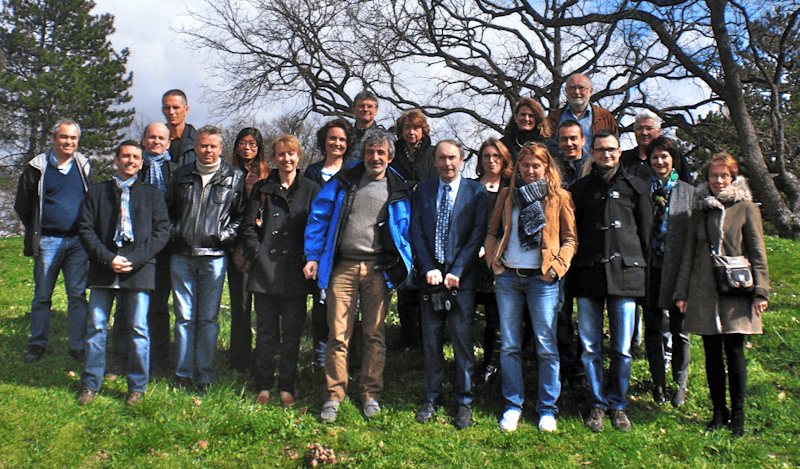
photo toulouse

Le Président de l’AFECT tient à remercier le Pr Christophe PASQUIER, Directeur de l’UFR de Pharmacie de Toulouse, pour avoir accepté d’accueillir cette troisième édition de notre séminaire de printemps, ainsi que pour la mise à disposition des locaux. De chaleureux remerciements doivent être adressés également à notre Collègue Pierre VERHAEGHE et à toute son équipe pour avoir assuré, avec brio et gentillesse, l’organisation matérielle de cette réunion.

1.    Bilan des activités des groupes de travail

mini logo afect  Commission enseignement

(Présentation : Alain GUEIFFIER)

La composition de cette commission, définie lors de l’AG de Clermont-Ferrand (28/03/2014) est la suivante :

  • Coordonnateur : Alain GUEIFFIER
  • Membres : Isabelle BAGLIN, Pascal BERTHELOT, Sylviane GIORGI-RENAULT, Cécile GUEIFFIER, Jean-François PEYRAT, Pierre VERHAEGHE

Une enquête a été menée au niveau national afin de faire le bilan des enseignements de Chimie Thérapeutique au sein des 24 facultés de Pharmacie ; l’objectif étant de pouvoir donner des arguments aux enseignants en difficulté au sein de leur UFR pour défendre la discipline. Cette enquête a été réalisée sous la forme d’un questionnaire envoyé par mail. A ce jour, 16 réponses ont été collectées, en sachant que le carnet d’adresse mail de l’AFECT peut nécessiter une mise à jour.

Cette enquête confirme une très grande disparité entre les UFRs, notamment au niveau des volumes horaires en fonction des modules mais également de la place de la Chimie Thérapeutique dans le cadre des UE internat (7h Marseille, 6h Toulouse, Montpellier, Bordeaux…)

On peut noter une faible participation aux enseignements de la filière industrie ; seules quelques interventions sur les dossiers AMM ou la conception de principes actifs sont réalisées dans quelques facultés.

Suite à discussion initiée à partir de cette enquête, sont ressortis les points suivants :

  1. Le niveau en chimie organique des étudiants en pharmacie a beaucoup baissé, ceci fait suite à une diminution de l’enseignement de la chimie organique en lycée puis en PACES. Il peut être envisagé de mettre en place des UE de rattrapage en 2ème année, comme cela est fait par exemple à Tours, cette UE étant composée de 1/3 de chimie analytique, 1/3 de chimie organique et 1/3 de botanique.
  2. Afin de faire comprendre aux étudiants en pharmacie, l’intérêt que peut présenter la chimie organique dans l’apprentissage de la chimie thérapeutique, il est proposé à Caen un enseignement transversal présentant la filiation chimique entre les différentes classes thérapeutiques qui sont traitées au cours des études en pharmacie.
  3. Afin de rendre la discipline plus attractive et de lutter contre la désertion des amphithéâtres, il est également possible de proposer dans les diaporamas des animations présentant des mécanismes d’action ou des interactions tridimensionnelles entre cibles et ligands.
  4. L’intégration de questions de chimie thérapeutique dans le cadre du CSP et de l’internat, peut être un moyen de soutenir la discipline.

En conclusion de la discussion, il est décidé de lister les classes thérapeutiques pour lesquelles seule la chimie thérapeutique est en mesure d’expliquer un mécanisme d’action moléculaire ou un effet indésirable, ceci en lien étroit avec la pratique. La rédaction d’un ouvrage est alors envisagée compilant tous ces exemples. P. DALLEMAGNE se propose de préparer trois exemples.

mini logo afect  Commission internat

(Présentation : Michel VIDAL et Vincent LISOWSKI)

La composition de cette commission, définie lors de l’AG de Clermont-Ferrand (28/03/2014) est la suivante :

  • Coordonnateur : Michel VIDAL
  • Membres : Caroline DUCROS, Vincent LISOWSKI, Pierre VERHAEGHE

Actuellement, le CNCI travaille à l’actualisation de la base de données pour les questions internat et ne souhaite pas intégrer de nouvelles questions.

Avec pour même enjeu de soutenir la discipline, l’intérêt n’est pas de créer et d’intégrer de nouvelles questions QCM de chimie thérapeutique dans la base de données, les QCMs n’étant pas discriminants dans le concours d’internat. En revanche, il est plus intéressant de proposer des dossiers clinico-biologiques intégrant des questions de chimie thérapeutique et en collaboration avec d’autres disciplines.

Il a été identifié des lacunes dans le programme du concours d’internat, comme par exemple les inhibiteurs de tyrosine kinases. La commission internat de l’AFECT a donc commencé à préparer des QCMs et des cas clinico-biologiques afin de les faire remonter au CNCI. Il faut en faire la publicité auprès des étudiants.

Concernant la filière IPR, une grande partie des étudiants de cette filière terminent en officine. Il y a au niveau national une réflexion sur l’avenir de la filière. Elle est amenée à disparaitre sauf quelques postes qui perdureraient en toxicologie, pharmacoépidémiologie, phamacogénomique, chimie thérapeutique…

mini logo afect  Commission e-learning

(Présentation : Alain NUHRICH)

La composition de cette commission, définie lors de l’AG de Clermont-Ferrand (28/03/2014) est la suivante :

  • Coordonnateur : Jean-François PEYRAT
  • Membres :  Isabelle BAGLIN, Caroline DECOMBAT, Abdallah HAMZÉ

Afin de rendre plus attractifs les enseignements de chimie thérapeutique, il a été proposé au dernier séminaire de printemps de réaliser des exercices sous forme de QCMs interactifs en libre accès pour l’autoapprentissage des étudiants. Deux exemples intéressants sont alors présentés :

1. Travail réalisé par Abdallah HAMZÉ (Paris-Sud)

Il est procédé à la projection d’une vidéo de démonstration transmise par l’auteur, et montrant l’état d’avancement du projet initialement présenté lors de notre séminaire de Clermont-Ferrand.

Abdallah HAMZÉ a developpé une application sur plateforme WIMS (WWW Interactive Multipurpose Server) constituée d’une banque d’exercices interactifs, destinée à l’entraînement des étudiants inscrits en 3e année à Châtenay-Malabry.

Lors de la discussion, il est proposé (sous réserve de l’accord préalable d’A. Hamzé ainsi que de la faisabilité technique) de mettre cette application à disposition des étudiants via un lien internet qui pourrait figurer sur le futur site web de l’AFECT.

La difficulté évoquée concerne le niveau de technicité requis pour alimenter cette base de données. Cela sous-entend la nécessité d’une formation pour les enseignants de chimie thérapeutique souhaitant s’impliquer dans cette nouvelle approche pédagogique. Il est suggéré la possibilité de financer des stages d’étudiants en informatique par l’AFECT.

2. Travail réalisé par Alain NUHRICH (Bordeaux)

La chaîne éditoriale Opale est un outil de choix pour la création de modules pédagogiques utilisables en formation présentielle, ou à distance. La publication du contenu pédagogique sous forme de site web autonome est particulièrement bien adaptée à la création de banques de questions de type QCM.

L’exemple présenté est un module d’entraînement interactif expérimenté à Bordeaux depuis février 2015. Il est destiné aux étudiants de 4e année préparant l’Internat et souhaitant faire le point sur leur niveau de connaissances dans le domaine des Relations Structure-Activité (programme de l’Internat, Section V : Sciences du médicament).

2.    Présentation du site internet

(Présentation : Alain NUHRICH)

À partir d’un travail initié en juillet 2014 par Nicolas MASURIER, Alain Nuhrich propose une maquette de site web pour notre association.

Ce projet a été conçu à partir du CMS[1] Joomla (version 3.4) qui est un outil de référence performant, utilisé par de très nombreux sites web dits « professionnels ».

Le site web proposé ici est de type dynamique. Comme pour tout site web, la gestion d’ensemble sur le plan technique, dépend d’un administrateur. Par contre, en terme de contenu, l’alimentation du site pourra être réalisée directement par tout membre AFECT « autorisé », sous le contrôle de l’administrateur.

La maquette présentée lors de cette réunion doit être considérée comme une ébauche, et nécessite bien évidemment des aménagements qui devront être discutés. Bien qu’expérimental, ce site est toutefois pleinement opérationnel : à ce jour, il pourrait être directement transféré « en l’état » sur un site hébergeur.

Deux possibilités sont évoquées :

  • Nicolas Masurier propose de le faire héberger par l’université de Montpellier.
  • Alain Gueiffier propose de chercher un hébergeur professionnel financé par l’AFECT.

[1] CMS : Content Management System (en français : système de gestion de contenu). Permet de créer des sites web sans avoir de connaissances particulières sur les langages HTML, PHP, etc.
Partager:

Plus articles

EFMC International Symposium on Medicinal Chemistry Bâle, Suisse

The EFMC International Symposium on Medicinal Chemistry is organised by the Division for Medicinal Chemistry & Chemical Biology (DMCCB) of the Swiss Chemical Society (SCS), on behalf of the European Federation for Medicinal chemistry and Chemical biology (EFMC). The symposium will take place in Basel, Switzerland from September 6-10, 2026.  The EFMC is the main organisation for the European Medicinal Chemistry and Chemical Biology community, with 31 member societies and about 9.000 members. Its biennial EFMC Medicinal Chemistry is a key symposium in the field of medicinal chemistry and drug discovery and it traditionally attracts around 1.000 participants both from industry and academia. The most recent EFMC-ISMC meeting took place in Rome (Italy, 2024). The scientific programme of EFMC Medicinal Chemistry 2026 will run over 5 days and will include plenary sessions and cover a wide range of selected topics split into 3 parallel sessions. We look forward to welcoming you to Basel in September! Organised by With the Support of Gold Sponsors Silver Sponsor Bronze Sponsors Media Partners

60th edition of the International Conference on Medicinal Chemistry

The French Medicinal Chemistry Society (Société de Chimie Thérapeutique – SCT) is pleased to invite you to Paris, France on July 1-3, 2026 for the 60th edition of the International Conference on Medicinal Chemistry (RICT 2026). The conference will be dedicated to “Interfacing Chemical Biology and Drug Discovery” and will include 18 plenary lectures and 6 short lectures. In addition, 2 plenary lectures will be delivered by the recipients of the Novalix SCT Award for Drug Discovery Chemistry and the Evotec Prize for Excellence in Molecular Design. As for previous editions of RICT, the scientific committee will ensure the high quality and diversity of the scientific programme together with the accessibility of the meeting to PhD/post-doc and local Master students. For the latter, an advantageous registration fee will be offered. In addition, a poster session will provide the opportunity for all participants to present their current results. Poster prizes will be attributed at the end of the meeting. A limited number of grants will be funded by the SCT and Corporate Sponsors to support the participation of young academic scientists presenting a poster at the conference. Find out more. Moreover, a special career session will be organised with industrial and academic participants. We look forward welcoming you in Paris! The Organising Committee Organised by Supported by EFMC Sponsored Event Gold Sponsor Silver Sponsor Bronze Sponsors Media Partners

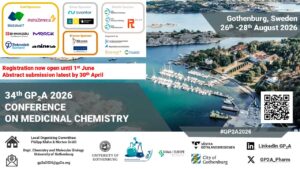
34th GP2A 2026 Conference on Medicinal Chemistry – Gothenburg, Sweden – August 26th to 28th 2026

Dear Colleagues, Dear Researchers, The GP2A (Group for the Promotion of Pharmaceutical chemistry in Academia) is delighted to announce the 34th GP2A 2026 Conference on Medicinal Chemistry, hosted by the City of Gothenburg, the Västra Götaland Region and Department of Chemistry and Molecular Biology at the University of Gothenburg, Sweden, 26–28 August 2026. The Conference is organized in collaboration with the SIGMA-1 Europe Cost Action (https://sigma1europe.eu/) The conference venue is the brand-new Natrium Research Building, a state-of-the-art facility in the Faculty of Science and Technology. City of Gothenburg/Göteborg Gothenburg. Always in progress. EN on Vimeo and Gothenburg official visitors guide www.goteborg.com/en  Welcome to Göteborg, Sweden’s vibrant coastal city where innovation meets Scandinavian charm. Set on the edge of a stunning archipelago, Göteborg offers a unique blend of maritime heritage, modern culture, excellent cuisine, and a relaxed, walkable city center. From picturesque canals and historic neighborhoods to world-class dining and green spaces, Göteborg provides the perfect setting for inspiring discussions and memorable conference experiences. Useful links for Gothenburg Tickets for public transport in Gothenburg – Download Link of the Mobile App of Västtrafik https://apps.apple.com/se/app/västtrafik-to-go/id424903083 Here is the link to the android app: https://play.google.com/store/apps/details?id=com.vaesttrafik.vaesttrafik&hl=sv You can find a description for the way from the suggested hotel (Comfort Hotel Panorama) here. You can find a description for the way from the other suggested hotel (Comfort Hotel Göteborg) here. Please find a link to a bus connection from Landvetter Airport to Gothenburg city (Station: Korsvägen) here. Conference Venue The Natrium Research Building, located on Medicinaregatan 7B in Gothenburg, offers modern lecture halls, teaching labs, and exhibition spaces, making it an ideal setting for an international scientific meeting. Participants will also have the opportunity to explore Gothenburg, a vibrant and beautiful city on Sweden’s west coast. Scientific Programme Scientific Programme Mark Brönstrup, Helmholtz Centre for Infection Research, Germany Magnus J. Johansson, AstraZeneca & Stockholms Universitet, Sweden Silvia Ortega Gutiérrez, Universidad Complutense de Madrid, Spain Maria Duca, CNRS Université Côte d’Azur, France Matt Todd, University College London, United Kingdom Laurence Lafanechère, Saxol & CNRS Université Grenoble Alpes, France Nina Hartrampf, University of Zurich, Switzerland Tangui Maurice, CNRS, INSERM U1198, France Carmen Abate, Università Degli Studi Di Bari, Italy Johannes Broichhagen, Leibniz Research Institute for Molecular Pharmacology, Germany Ed Tate, Imperial College London, UK …and more to come. Confirmed Scientific Sponsor Presentation Alexander Neumann, BioSolveIT, Germany Björn-Thoralf Erxleben, Shimadzu Sverige, Sweden Mikael Friberg, Merck Life Sciences, Sweden The preliminary Program is available HERE. Flyer: Available here. Hands-on Workshop – Modeling with SeeSAR by BioSoveIT (https://www.biosolveit.de/) With an exciting hands-on learning session with the title “Medicinal Chemistry in Motion: Introduction to Rational Compound Design” BioSolveIT will contribute to our scientific programme.  You will learn how structure-based drug design supports lead optimization by turning binding-mode insights into actionable ideas for decorating and improving ligand scaffolds.What makes BioSolveIT workshops special is their interactive, beginner-friendly format: using our drug design dashboard SeeSAR, you can explore binding prediction, fragment-growing strategies, scaffold exploration, and more. No computational chemistry expertise required, though experts will find plenty of depth. Please bring your own laptop and install SeeSAR in advance (find instructions here: https://www.biosolveit.de/workshops/gp2a-2026/); registered participants will receive a workshop license so you can continue testing the software for several weeks after the session. Please find instruction for the installation and the registration to the workshop here: https://www.biosolveit.de/workshops/gp2a-2026/. Please note that only people registered to the conference will have access to the workshop. Registration and Conference fee Registration and fees: You can pay either by credit card or bank transfer (via purchase order for French colleagues). The fee includes the welcome reception on Wednesday evening, lunch on Thursday and Friday, and coffee breaks on all days. The dinner and social activity are optional at €68. Category Fee [€] Junior Researcher & GP2A Member 150 Junior Researcher 170 Senior Researcher & GP2A Member 300 Senior Researcher 330 Sponsor 330 Junior Researcher: PostDocs, PhD and Master students Senior Researcher: PIs, Professor, Lecturer   If you are not already a member, and would like to join GP2A, please use the following link: https://gp2a.org/index.php/gp2a-membership/ Please register here: https://gp2a.s2.yapla.com/en/event-101283/ Registration opens on 31th of January 2026. Book your seat early, there are limited seats available. Deadline for registration is the 1st of June 2026. Abstract submission The abstract template for young researcher presentations, poster-pitches and poster presentations and information for the submission are available here. Please submit your abstract exclusively using the dedicated word template as a DOCX file here by the 30th of April 2026.  Please note that abstracts not fulfilling the template format will not be accepted. Abstract submission and poster/communication will eventually not be considered if the main author is not fully registered as a participant to the conference by the closing date for abstract submission (1st of June 2026). Young Researcher Presentations and Poster Pitches: The organizing committee will select 10 attendees from the submitted abstracts for a Young Researcher Presentation (15 + 5 min)and 20 attendees for a Poster Pitch (3 min). Please select “no communication” during the abstract submission process, in case you do not wish to be considered for any oral communication, to notify the organizing committee of your preference. Participants selected for Young Researcher Presentations and Poster Pitches will be notified shortly no later than 1st of June 2026. The date for final registration (without abstract submission) is 1st of June 2026. Prizes will be awarded for the Best Posters, Best Poster Pitch and Best Young Researcher Presentation. Social Programme Welcome Reception On the evening of the 26th of August we will have a Welcome Reception in the Atrium of the conference Venue with food and beverages. the Welcome Reception is included in the conference fee. Conference Dinner: An Evening Cruise through the Gothenburg Archipelago You can find a description for the way from the conference venue to the departure point of the conference dinner cruise Lilla Bommens hamn here. We invite you to a truly unique conference dinner and social activity on board the historic M/S St. Erik. Experience a 3-hour boat tour through the stunning Gothenburg archipelago, offering breathtaking coastal scenery, open waters, and unforgettable views. On board, guests will enjoy a Shrimp & Salmon Seafood Dinner, served in a relaxed and elegant maritime atmosphere. The dinner includes one drink (wine or beer) and table water. Additional beverages will be available for purchase on board.  Vegetarian, vegan or other dietary restrictions will be considered when communicated during registration. This special